What happened
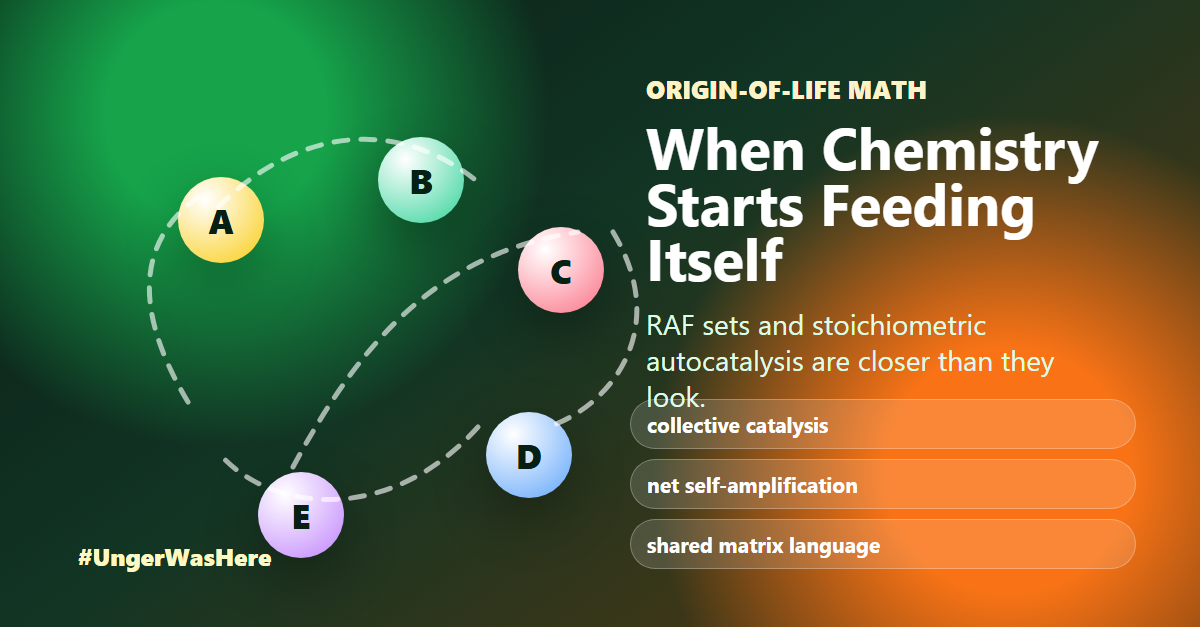
A new paper bridges two frameworks for autocatalysis that have often lived in separate lanes. RAF theory focuses on sets of reactions where molecules collectively catalyze each other's formation. Stoichiometric autocatalysis focuses on reaction networks that are net-productive and self-amplifying. Richard Golnik and coauthors show these views are more compatible than they look, using stoichiometric matrices as the shared mathematical representation.
The significance is not just terminology. If origin-of-life models can translate between "collectively self-maintaining" and "net self-amplifying," researchers get a cleaner language for comparing candidate pathways from chemistry to biology.
The big picture: life may not begin with one magic molecule. It may begin when a network crosses the threshold where its own products help keep the network going.
Source
Reported by Bridging two theoretical frameworks of autocatalysis: RAF sets and stoichiometric autocatalysis via arxiv.org, published May 25, 2026.