What happened
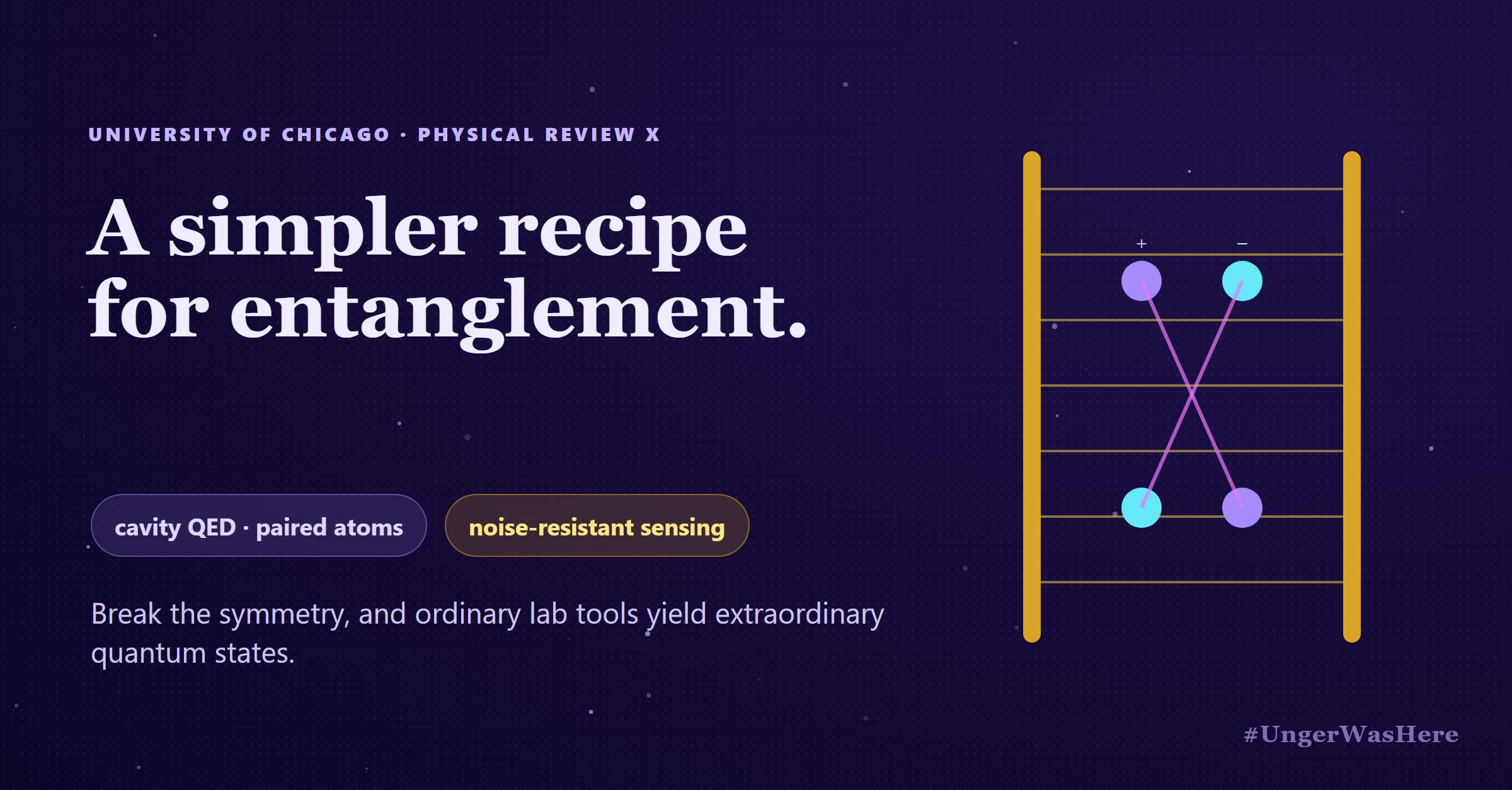
Highly entangled states are what give quantum sensors and computers their edge, but building them usually takes delicate, hard-to-scale setups. In Physical Review X, researchers at the UChicago Pritzker School of Molecular Engineering showed you can generate them inside an ordinary optical cavity by shifting the atoms' excited-state energies in equal-but-opposite pairs to break a symmetry, then driving every atom with a single laser. The payoff is a famously useful entangled state, the AKLT state, made with common lab tools and read out with standard Ramsey measurements.
Why this matters: the whole point is robustness. These states resist noise and can sense things like tiny field gradients that normally get washed out, which is exactly what real-world quantum sensing needs. First author Anjun Chu put the appeal plainly: you turn these lasers on and wait.
This is still theory, not a benchtop demo. But "do more with the equipment you already have" is how quantum quietly moves from physics paper to practical tool. Senior author Aashish Clerk and the Q-NEXT team at Argonne are betting simplicity scales. For the quantum builders here, what bottleneck would a simpler entanglement recipe actually remove for you?
Source
Reported by Scientists found a surprisingly simple way to create powerful quantum states via sciencedaily.com, published June 6, 2026.