What happened
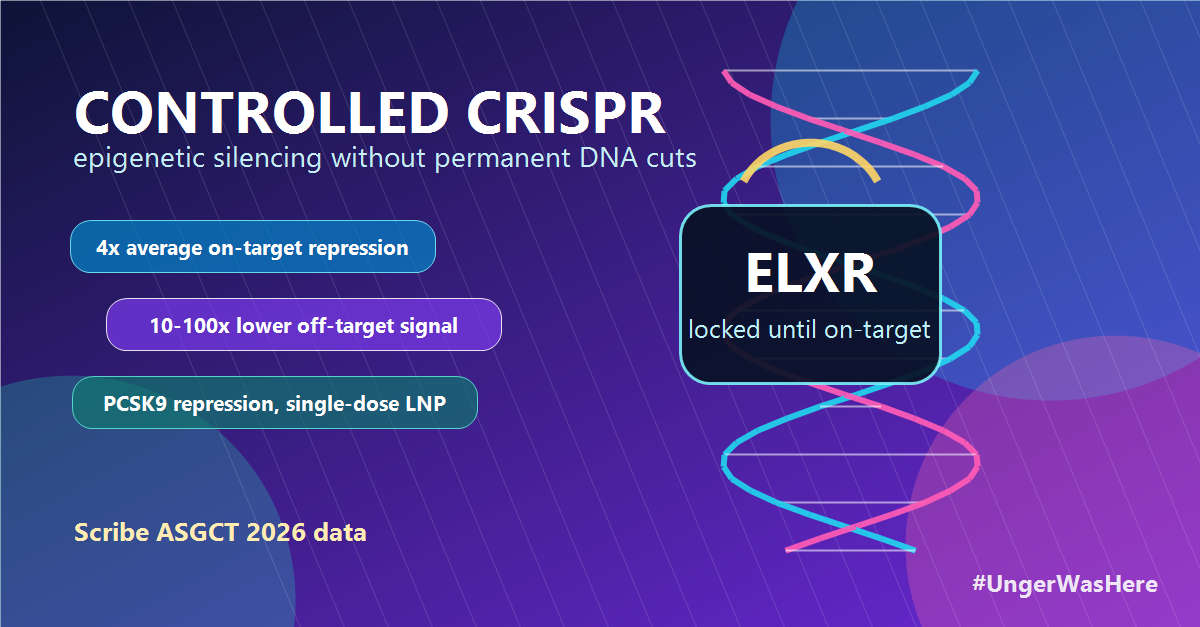
The company says its allosteric ELXR epigenetic silencer is designed to repress target genes without permanent DNA changes. In preclinical work, Scribe reported at least a 4x average improvement in on-target repression across spacers, roughly 10-to-100x lower off-target transcriptional effects versus non-allosteric molecules, and durable PCSK9 repression after single-dose LNP delivery in non-human primates.
The bigger signal is the stack: engineered CasX-derived editors, epigenetic control, guide design, and AI-enabled DeepXE modeling. Biotech is starting to look less like one breakthrough molecule and more like a programmable engineering discipline.
The practical question for drug developers is no longer only "can CRISPR edit?" It is "can the whole system be made specific, durable, scalable, and clinically boring enough to trust?"
Source
Reported by Scribe Therapeutics Reports Preclinical Data at ASGCT 2026 Demonstrating Enhanced Potency and Specificity of Engineered CRISPR Technologies for Epigenetic Silencing and Gene Editing via scribetx.com, published May 18, 2026.