What happened
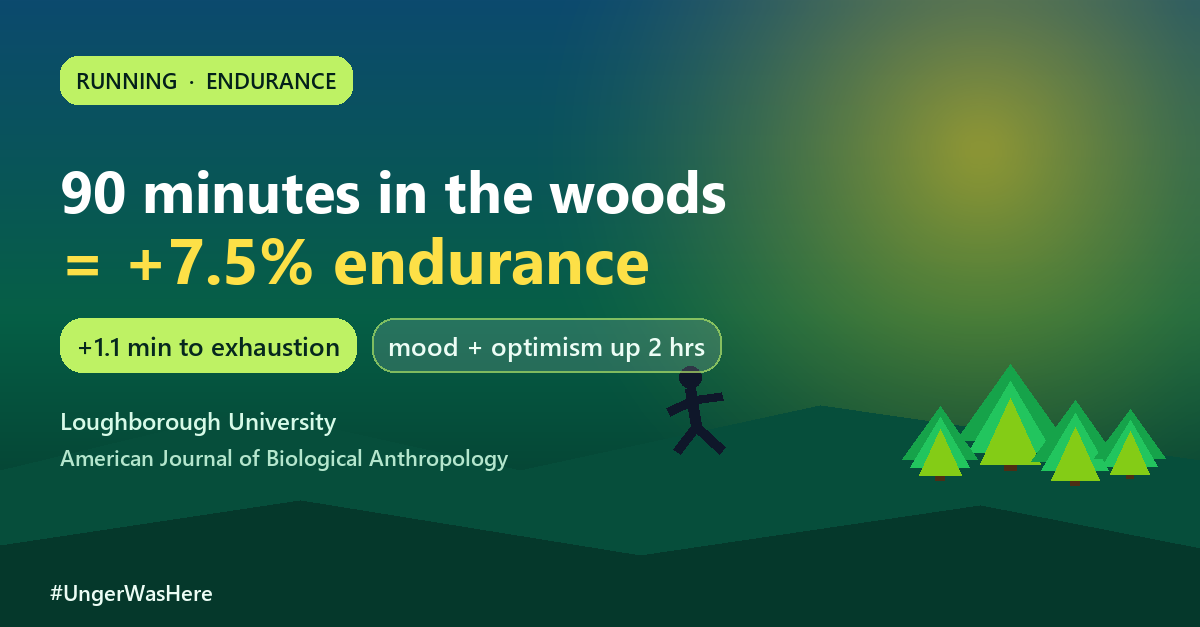
In a randomised crossover trial from Loughborough University, 25 adults spent 90 minutes in either ancient woodland or an urban industrial setting, then cycled to exhaustion in the lab. After the woodland visit they lasted 7.5% longer, about 1.1 minutes more, even though oxygen uptake and the usual cardiorespiratory numbers barely moved. Mood and optimism rose and stayed elevated for up to two hours, hinting the gain is at least partly psychological. The work is published open access in the American Journal of Biological Anthropology.
Why this matters: lead author Dr. Danny Longman frames it through an Environmental Mismatch Hypothesis, the idea that 200 to 300 years of industrialisation has outrun our biology, leaving us a little ill-suited to the noise, pollution, and artificial light we now live in. Forests are the habitat we actually evolved in, and our bodies still seem to respond. For runners and endurance athletes, that reframes green space from a nice-to-have into part of the training itself.
It is one small study, 25 people, a single session, so treat the exact 7.5% with care. But "where you train may matter as much as how hard" is a genuinely useful prompt. Where do you log your best long miles, trails or pavement, and can you feel the difference?
Source
Reported by Spending time in nature could boost endurance by 7.5%, new research finds via lboro.ac.uk, published June 3, 2026.